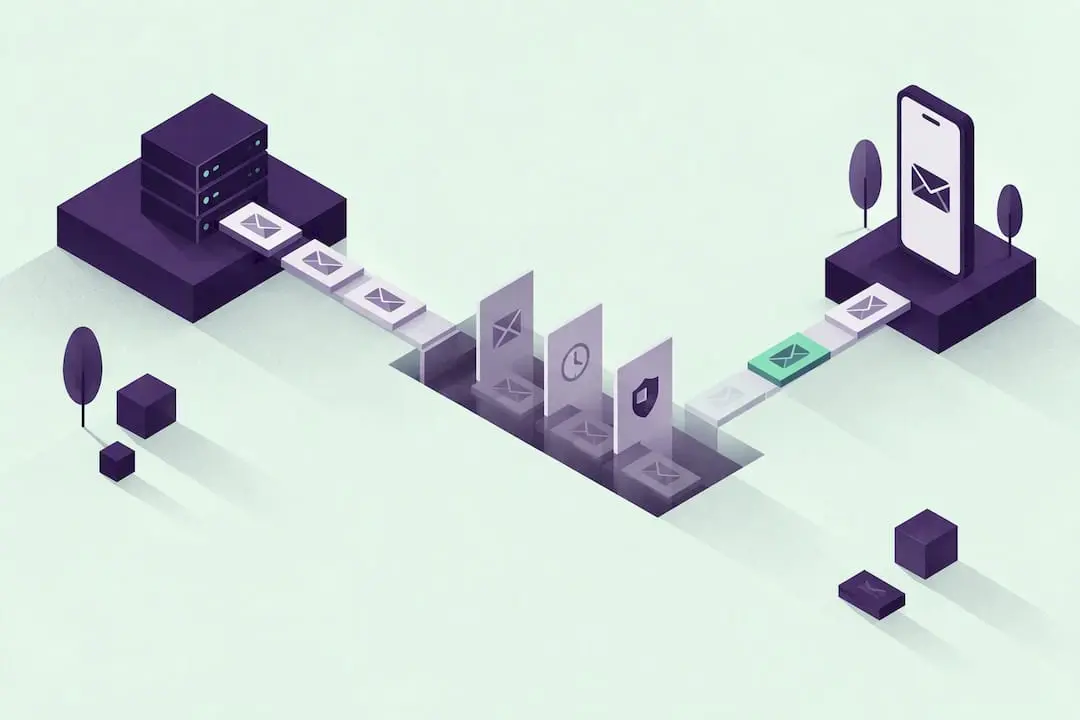
SMS deliverability is the share of messages that actually reach a handset, confirmed delivered rather than merely sent: delivered messages divided by messages attempted. The single best first move is to stop trusting "sent" status and start tracking delivery receipts (DLRs) while confirming that every recipient gave valid, current opt-in consent.
TL;DR:
- Using delivery receipts instead of "sent" status provides a more accurate measure of actual message delivery.
- Carriers often delay or block messages due to filtering, number issues, consent violations, or throttling, not necessarily platform faults.
- Matching number type and content with sending pattern and routing infrastructure can significantly improve delivery rates while balancing cost.
- Tracking delivery latency and engagement signals helps identify delays and failures caused by carrier congestion or device issues.
- A reliable deliverability target is a stable, high rate with quick detection of drops, and combining consent management with proper routing optimizes overall success.
Table of Contents
- How SMS submission and delivery actually work
- Common causes of SMS delivery failure
- What actually moves your delivery rate
- How to measure deliverability correctly
- Prioritized best practices to raise your delivery rate
- How Notix fits into deliverability engineering
- What a realistic deliverability target looks like
- Get started with Notix on email and SMS deliverability
- FAQ
- Sources
How SMS submission and delivery actually work
When you send a text, your platform hands it to a short message service center (SMSC), which queues the message and routes it toward the recipient's carrier. From there it crosses to the terminating carrier, which attempts to push it to the actual handset. Your API usually reports "sent" the moment the SMSC accepts the message, not when a phone receives it. That gap matters because a message can get accepted, then dropped, delayed, or filtered anywhere downstream.
Delivery receipts (DLRs) close that gap by confirming what happened after submission. The GSMA's technical overview describes SMS delivery as a two-step process, submission then delivery, and notes that delivery reports remain optional in many networks, which is why some carriers suppress or delay them.
A few mechanics shape what you see in your dashboard:
- The SMSC retries and queues messages when a handset is off, out of range, or roaming.
- Number portability can route a message to the wrong carrier briefly after a number switches providers.
- International traffic often passes through interconnect hubs, adding hops where failures can occur.
- Protocol transitions, from older MAP signaling toward Diameter and HTTP/2, are changing how carriers exchange delivery status.
Common causes of SMS delivery failure
Most failed texts trace back to a handful of repeat offenders. Work through these in order of likelihood before assuming it is a platform problem.
- Carrier filtering: Carriers run spam and content filters that block messages resembling bulk marketing, phishing, or known abuse patterns, often without notifying the sender.
- Number problems: Reassigned, ported, or simply invalid numbers fail silently or bounce hard, and a number with a poor sending history can get throttled even when valid.
- Consent and compliance blocks: Missing or outdated opt-in records, ignored opt-outs, or do-not-call conflicts can trigger carrier-level or regulatory blocking.
- Recipient-side conditions: A powered-off handset, full inbox, or active roaming delays delivery until the device reconnects.
- Carrier throttling: Sudden volume spikes from one sender ID or route can get rate-limited mid-campaign, stalling an otherwise healthy send.
Regulatory shifts raise the stakes on the consent category specifically. The FCC's Second Report and Order establishes mandatory blocking duties and one-to-one prior express written consent requirements for certain automated texts, which means a sloppy consent process does not just risk a complaint, it risks your messages getting blocked at the carrier level before they ever reach a phone.
What actually moves your delivery rate
Four controllable choices do most of the work: number type, message content, sending pattern, and routing infrastructure. Each trades off cost against reliability differently.
- Number type: Short codes handle high volume reliably but cost more and take longer to provision; long codes are cheap and fast to set up but get filtered more aggressively at scale; toll-free numbers sit in between, suiting moderate, verified-use volumes.
- Content and format: Avoid classic spam triggers (excessive punctuation, all caps, shortened unbranded links), keep messages concise, and use a recognizable sender identity so carriers and recipients both trust the source.
- Sending pattern: Bursting your full list at once invites throttling; staggered sends with exponential backoff on retries keep you under carrier rate limits.
- Routing infrastructure: Direct operator connections offer the most control and the fewest hops, while SMS hubs trade a bit of control for broader international reach and simpler failover.
Pro Tip: Route link-based messages through a reputable, branded domain rather than a generic shortener; carriers increasingly flag unfamiliar short-link domains as spam signals.
How to measure deliverability correctly
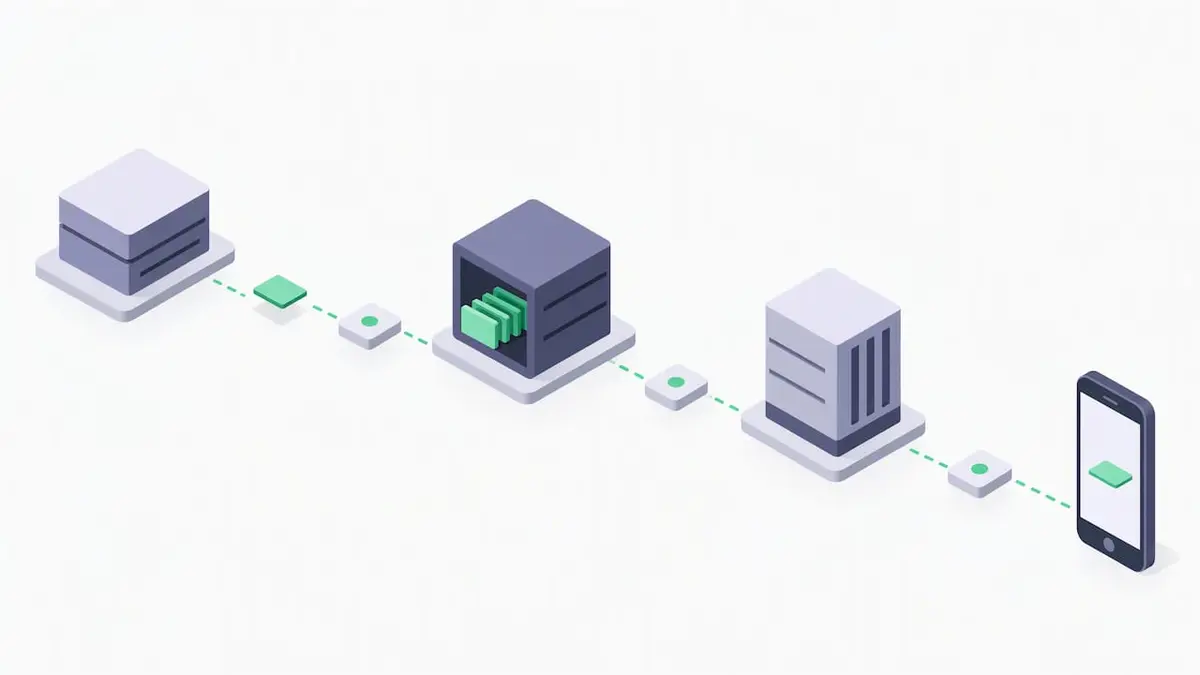
The delivery rate formula is simple on paper: DLR-confirmed deliveries divided by total attempts. The hard part is trusting the numerator, since "sent" status from your API only confirms the SMSC accepted the message, not that it reached a phone.
Break failures into two buckets. A hard bounce means permanent failure, typically an invalid or disconnected number, and should trigger immediate suppression. A soft bounce, like a temporarily unreachable handset or a carrier-side deferral usually resolves on retry and should be tracked separately so it does not skew your hard-failure rate.
- Track delivery latency, not just final status, since delayed delivery often signals carrier-side congestion or throttling.
- Use engagement signals, such as link clicks or OTP verification success, as a secondary confirmation layer.
- Segment every metric by number type, route, and recipient country, since a healthy blended rate can hide a badly underperforming segment.
Engagement data as a delivery proxy carries real weight here: the GSMA notes that some carriers suppress or delay DLRs, which means a confirmed OTP entry or link click can be a more reliable delivery signal than the receipt itself.
Prioritized best practices to raise your delivery rate
Work through these roughly in order. The first few carry the highest impact for the least engineering effort.
- Lock down consent first. Document opt-in clearly, consider a double opt-in step for new contacts, and process opt-out requests immediately. The FCC's waiver order delayed certain revocation-rule deadlines specifically to give senders time to update these systems, which signals how seriously regulators now treat consent handling.
- Match your number type to your volume. A dedicated long code suits low-to-moderate transactional traffic, a toll-free number fits moderate verified campaigns, and a short code justifies its cost once volume and compliance needs scale up.
- Clean your content before you clean your code. Strip spam-trigger words, shorten messages, personalize lightly, and link only through a reputable branded domain.
- Throttle and segment your sends. Stagger bursts, apply exponential backoff on retries, and route failed messages through a fallback path rather than retrying blindly on the same route.
- Automate suppression and hygiene. Strip reassigned and invalid numbers on a recurring schedule rather than relying on manual list cleanup.
- Watch for regressions, not just averages. Set alerts for sudden drops in delivery rate by carrier or route, since a silent filtering change can quietly tank one segment while your overall number still looks fine.
Pro Tip: If you run OTP verification, pair your delivery receipts with a recovery link to confirm actual delivery; a tool like Scanza's server-side tracking approach can help recover and validate engagement signals that client-side tracking misses, which strengthens that confirmation layer further.
How Notix fits into deliverability engineering
We built our platform around the controls this guide covers, not as a replacement for good process but as the infrastructure that makes it easier to run.
- A single API handles both email and SMS, so delivery receipts and engagement data live in one place instead of two disconnected dashboards.
- We capture DLRs automatically and surface soft versus hard bounce status per message.
- Double opt-in and automated suppression apply across both channels, so a bounce or revocation on one feeds the other.
- Built-in retry and fallback logic handles deferred deliveries without custom engineering work.
- Our SMTP relay and email API share the same suppression and reputation data as our SMS sends.
We back this with a high-availability SLA and transparent pricing, so you know what reliability costs before you commit to it.
What a realistic deliverability target looks like
Networks drop messages for reasons outside anyone's control, roaming gaps, dead handsets, momentary carrier congestion. A better goal is a stable, high delivery rate with fast detection when it slips.
Move to a dedicated number or a premium route only when volume or compliance risk justifies the added cost, not by default. And treat deliverability as shared ground between marketing and engineering: one owns consent and content, the other owns routing and monitoring, and neither can fix it alone.
— Paul
Get started with Notix on email and SMS deliverability
If you are piecing together delivery receipts, suppression lists, and opt-in records across separate tools, we built Notix to put all three in one place. Our single API handles email and SMS together, so a bounce or an opt-out on one channel automatically updates suppression on the other, and you get DLR data without stitching together multiple carrier dashboards.
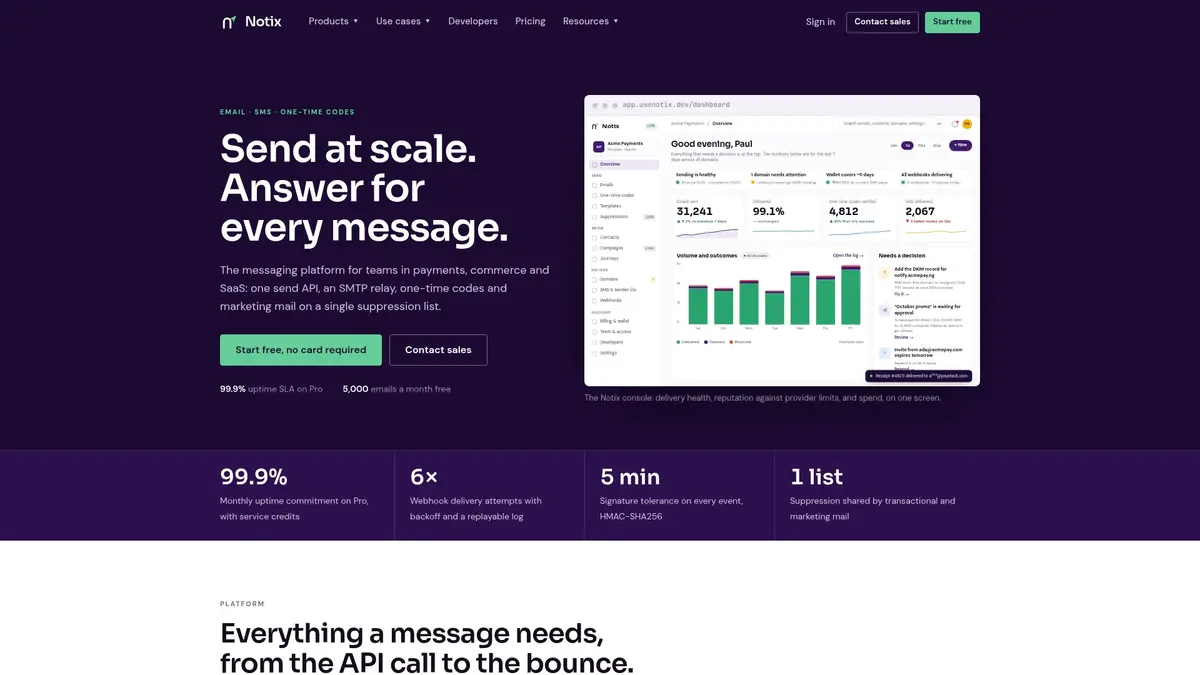
A simple way to validate this for yourself: send a small batch through our Email API, check the delivery receipts and engagement data in your dashboard, and compare that against what your current setup reports for the same list.
- Start on our Free plan to test delivery receipt tracking and suppression on a limited volume.
- Move to Pro at $15 per month once you need higher sending volume with the same tooling.
- Reach out for an Enterprise plan if your volume or compliance requirements call for a custom agreement.
Our documentation hub walks through setup if you want to see the API before committing to a plan.
FAQ
Is SMS becoming obsolete as a marketing channel?
No, SMS remains a primary channel for transactional and marketing messages precisely because delivery and open rates tend to outperform other channels when consent and routing are handled correctly. The shifts worth watching are regulatory, like the FCC's consent and blocking rules, not declining relevance.
Do SMS texts always get delivered once sent?
No. "Sent" status only confirms your gateway accepted the message, not that it reached the handset, since the GSMA's technical overview describes SMS delivery as a two-step process, submission then delivery, and notes that delivery reports remain optional in many networks. Tracking DLRs, not sent status, is the only way to confirm actual delivery.
Is SMS text blasting illegal?
Sending bulk SMS without proper consent can violate consent and blocking rules outlined in FCC orders, which require prior express consent and prompt handling of opt-out requests. The legality depends on your consent records and how you handle revocations, not on message volume alone.
What causes a delay in delivering SMS messages?
Delays usually come from carrier-side queuing when a handset is off, roaming, or out of signal range, or from throttling when a sender exceeds a carrier's rate limits. The GSMA's technical overview describes SMS delivery as a two-step process, submission then delivery, explaining that SMSCs retry and queue messages when a handset is off, roaming, or out of range, which is why a delayed message often still arrives without any action from the sender.